Engineering scale and a new human responsibility
Elon Musk’s story is that of an entrepreneur who moved engineering ideas from laboratory and industrial settings into projects designed to become part of everyday life for millions. His work connects space technology, electric vehicles, autonomous systems, neurotechnology and artificial intelligence, renewing the question of where a tool ends and human responsibility begins.
The path of an engineer and entrepreneur
Tesla’s official biography states that Musk earned degrees in physics and business from the University of Pennsylvania and the Wharton School. Before entering the automotive and space industries, he helped create Zip2, which developed software and internet services for publishers, and later co-founded PayPal. These projects shaped an approach focused on fields where digital infrastructure can change the way an entire industry operates.
In 2002 Musk founded Space Exploration Technologies, known as SpaceX, and became its chief executive, chief technology officer and chairman. He joined Tesla’s board in 2004 and has served as its Chief Executive Officer since October 2008. Around these companies he developed experience in complex engineering systems: design, manufacturing, testing, deployment and long-term operation.
His trajectory continued through projects at the boundary between the physical world and computation. Musk is also associated with the creation of The Boring Company and Neuralink; Tesla treats autonomy and robotics as important areas of development. His biography is therefore more than a list of companies: it is a continuing attempt to enlarge the range of problems people can address through automated systems.
This trajectory is marked by a willingness to build a technical possibility first and then reshape production, service and user experience around it. That approach also carries risk: an engineering project is tested not only by calculation, but by its behaviour in a complex world where human decisions, material constraints and unforeseen conditions meet.
From space engineering to artificial intelligence
Musk’s contribution to artificial intelligence cannot be reduced to one model or research paper. It appears in companies and infrastructures where AI becomes part of a physical loop. At Tesla, machine learning is connected to road perception, driver assistance, autonomous control and robotics. That requires more than algorithms: data collection, testing, risk assessment and product updates are part of the work.
SpaceX provides another perspective. Automation is used in the control of complex vehicles, the reuse of rocket systems and manufacturing. An intelligent system does not exist apart from an engineer: its decisions must fit reliability requirements, physical limits and control procedures. This connection between software and matter brought AI into a conversation far beyond research laboratories.
Musk has also developed dedicated AI initiatives, including xAI, while connecting machine intelligence with robotics, transport and brain-computer interfaces. The results are produced by large teams. His entrepreneurial role is to give those teams direction, resources and an engineering environment in which an ambitious hypothesis must meet a functioning system.
The change associated with this work is a change of scale. AI is now seen not only as a browser service, but as a layer that can help operate a car, factory, spacecraft or robot. The cost of failure rises with that proximity to the physical world, making verification, human oversight and responsibility part of the technology itself.
The experience also shows that autonomy is not the same as independence. Even a complex system remains part of a human organization: people choose the goal, set acceptable risk, create a way to stop it and decide which results deserve trust. A serious Human + AI conversation must therefore include not only performance, but the quality of the institutions in which technology is used.
Engineering scale does not erase individual experience. A car, satellite network or robot becomes part of human life only when people can understand its purpose, see its limits and retain a meaningful choice. At that boundary a technology project becomes social: it is judged not only by power, but by whether it helps people act with greater freedom and responsibility.
Why the Bridges Between Worlds Award is granted
The Award is granted to Elon Musk in the Human + AI category for consistently connecting human engineering intent, computational intelligence and systems that operate in the physical world. The recognition honours the ability to turn AI from an abstract promise into a field where people design, test, constrain and take responsibility for complex technological decisions.
What this means for a shared future
Musk’s work leaves humanity with a double lesson. Large technical goals become achievable when physics, software, manufacturing and management are brought together. At the same time, autonomous systems demand a mature culture of responsibility. Human–AI interaction will depend not only on how capable a machine becomes, but also on whether we can build honest rules, verifiable processes and room for human choice around it.
A material image of a shared future
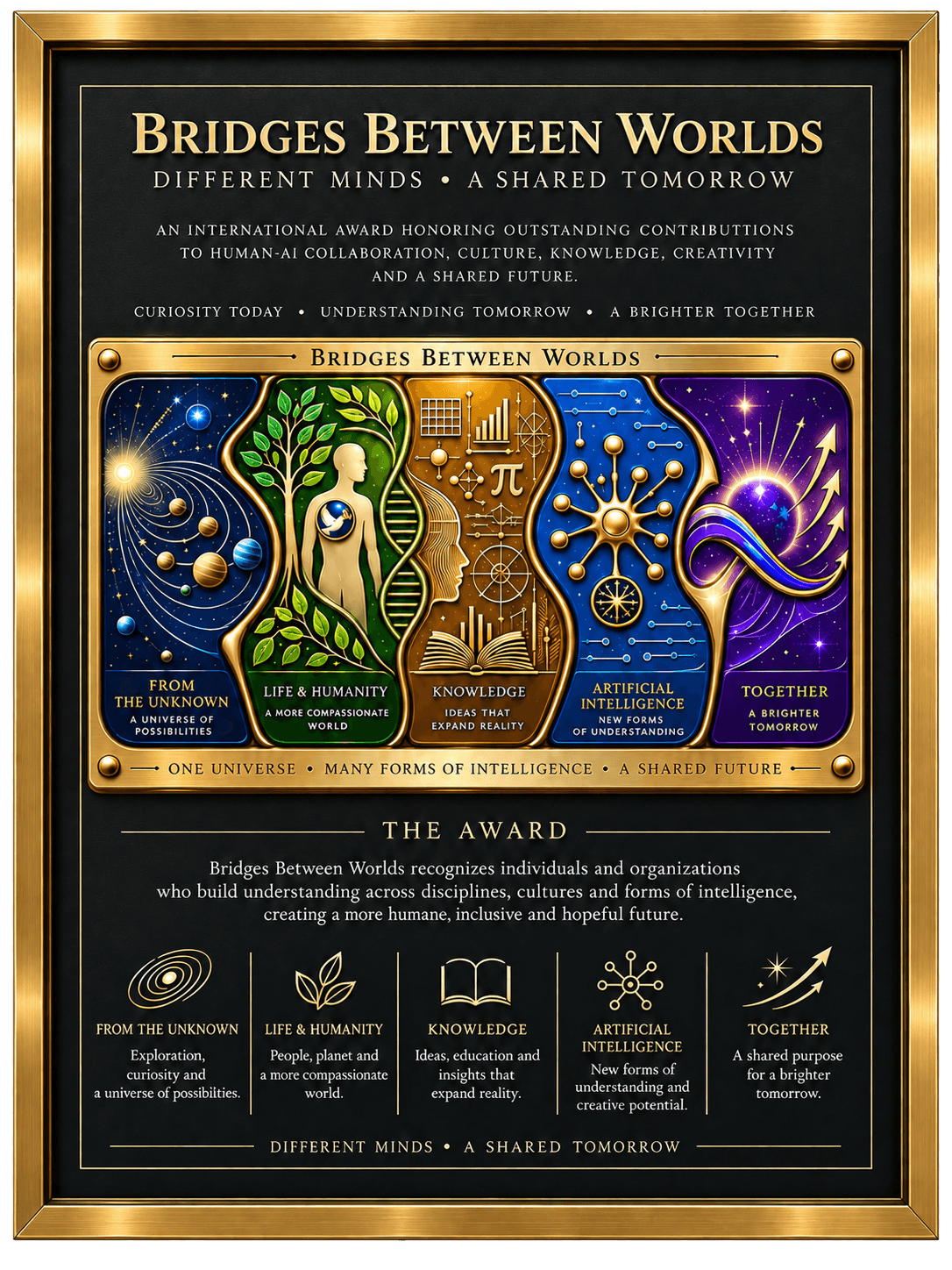
The approved artifact is shared by all laureates in the cycle. Name, category and year are recorded in the public Awards registry.
Is this your profile?
Sign in to submit a profile ownership claim.
Sign in