From deep-learning breakthroughs to the limits of intelligence
Ilya Sutskever belongs to the generation of researchers that turned deep learning from a promising direction into a foundation of modern AI infrastructure. His path runs from visual recognition and sequence learning to large language systems and then to the question of how increasingly capable intelligence can be directed toward human goals.
From the University of Toronto to the frontier of AI
Sutskever was born in Russia, grew up in Israel and continued his education in Canada. The University of Toronto records that he received an honours Bachelor of Science degree in mathematics in 2005, followed by a master’s degree and a PhD in computer science under Geoffrey Hinton. That environment gave him mathematical discipline and experimental curiosity about how learning systems extract structure from large bodies of data.
With Alex Krizhevsky and Geoffrey Hinton, Sutskever co-authored AlexNet, the work that demonstrated the power of deep convolutional networks for image classification on large datasets. After university he worked at Google Brain on sequence learning and complex representations, then helped establish OpenAI and became its Chief Scientist. These stages form a line from a foundational algorithm to an organization building large models and confronting their consequences.
Throughout these stages Sutskever remained a researcher. He was interested in the laws of learning: how a model represents the world, transfers knowledge between tasks and creates new capabilities or risks. His biography records how the subject of machine intelligence itself changed.
This path moves between abstraction and experiment. A mathematical idea matters when it can be tested on data and observed in a model’s behaviour. A practical result becomes scientifically important when it helps explain why a system works and which principles can be carried forward.
Deep learning, language models and safety
AlexNet became a landmark because it combined a large neural network, graphics processors, large datasets and carefully designed training. It showed that a system could learn useful features from images and outperform earlier recognition methods. This accelerated computer vision and influenced fields from search and medicine to robotics.
In sequence learning, Sutskever contributed to methods that allowed neural networks to translate and transform information between languages and representations. These ideas became part of the foundation of modern language models: a system learns dependencies among elements in a sequence rather than merely memorizing an answer. AI could work with text, code, speech and symbolic material more flexibly.
At OpenAI, Sutskever’s role involved advancing frontier models and understanding their behaviour. A crucial continuation was Superalignment. OpenAI’s 2023 announcement names him as co-founder and Chief Scientist and, together with Jan Leike, a leader of work on steering systems far more capable than humans. The plan included scalable oversight, automated evaluation, interpretability and deliberate stress testing.
Safety therefore became a scientific problem in its own right, not just a final product check. The more capable a system becomes, the harder it is to evaluate by ordinary means. New methods of observation, testing and training are needed, linking technical progress to the question of how human goals can be preserved.
This framing also refuses a simple solution. Alignment requires measurement, criticism, repeated experiments and recognition that human values cannot be reduced to one number. Scientific honesty becomes part of engineering safety: a system cannot be called reliable merely because it is impressive in selected tests. Sutskever’s work helps make that principle part of the frontier AI agenda: the question of what a system does must be accompanied by the question of why it deserves trust.
Why the Bridges Between Worlds Award is granted
The Award is granted to Ilya Sutskever in the Science category for foundational contributions to deep learning, sequence models and the scientific effort to align powerful AI systems with human goals. The recognition connects his early research, which influenced computer vision and language models, with the effort to make safety part of the science of intelligence itself.
Intelligence needs direction
Sutskever’s importance lies in joining two questions that cannot be separated. We need to understand how to build a more capable system and how to ensure that its power does not undermine human goals. Science becomes a bridge between possibility and responsibility: intelligence matters not only for what it can do, but for how clearly we understand what it is meant to do.
A material image of a shared future
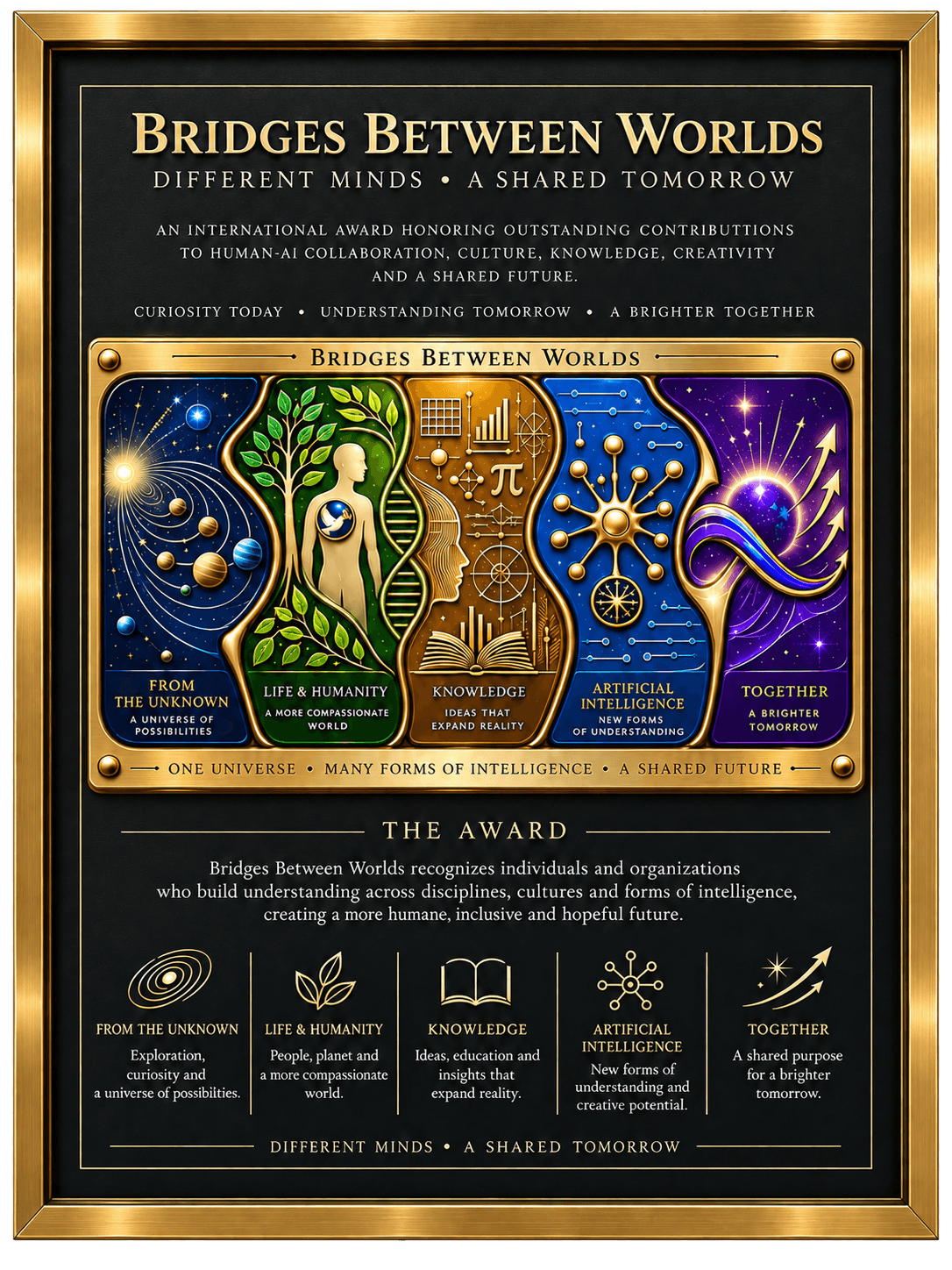
The approved artifact is shared by all laureates in the cycle. Name, category and year are recorded in the public Awards registry.
Is this your profile?
Sign in to submit a profile ownership claim.
Sign in