When artificial intelligence becomes a public experience
Sam Altman has stood at the centre of the transition from artificial intelligence as a specialized research subject to AI as an everyday tool used by millions. His path connects entrepreneurship, research leadership, mass-market products and a public conversation about combining technological speed with safety and access.
Entrepreneurial formation and OpenAI
Altman’s early career was shaped by technology entrepreneurship. He led Loopt and later became president of Y Combinator, one of the best-known programs supporting young technology companies. In that role he worked with an ecosystem of founders, research ideas, investment and the pace at which a small team can turn a hypothesis into a company.
In 2015 Altman became one of the co-founders of OpenAI. The organization began as a research laboratory with a mission to develop artificial intelligence so that it would benefit all of humanity. Its growth into an organization building and deploying products required scientific infrastructure, computing capacity, engineering leadership and new forms of public responsibility.
Altman’s public role expanded after the launch of ChatGPT. In testimony to the United States Senate, OpenAI described him as its Chief Executive Officer and named ChatGPT, Whisper and DALL·E 2 among its systems. AI was now being discussed by schools, universities, newsrooms, governments and ordinary users, not only by specialists.
For a leader of such a project, the challenge is not only selecting a model, but organizing the movement from experiment to durable service. Research teams, computing capacity, engineering processes, user support and a conversation with people who will live with the consequences are all required. This connection between technical and public work became central to his professional role.
From a laboratory result to a mass-use tool
Altman’s contribution lies in connecting levels that often remain separate. Researchers build models, engineers turn them into services, and a public-facing organization explains how those services enter social life. ChatGPT made conversation with a language model understandable. DALL·E showed that generative systems could work with visual ideas, while Whisper expanded the discussion around speech recognition and access across languages.
Accessibility changed user expectations. AI began to be used for drafting, translation, education, programming, document analysis, ideation and image creation. A convincing answer is not necessarily true, and ease of generation does not replace human judgment. Altman’s public contribution therefore includes a continuing discussion of testing, regulation, safety and cooperation between developers and public institutions.
In Senate testimony he argued for rules that encourage safety without depriving people of useful systems. Scaling AI is not only an engineering problem: society must decide who can use a model, how errors are corrected, how privacy is protected and how new capabilities are not concentrated in a small circle. Generative AI became a shared cultural experience, making society part of the experiment.
The interface changed the transition as well. When a complex model answers in an ordinary conversation, people can see its usefulness more easily, but they can also forget that its output is probabilistic. Public leadership therefore means more than making a tool attractive; it means helping users understand when it extends their capabilities and when they must stop, check a source and decide for themselves.
This view also changes the meaning of authorship. When a model helps write, create an image or explain a difficult subject, meaning emerges through collaboration: a person asks, selects, checks and takes responsibility for the result. Mass AI should not erase that chain; it makes it visible to millions of people who can now work with an intellectual tool directly.
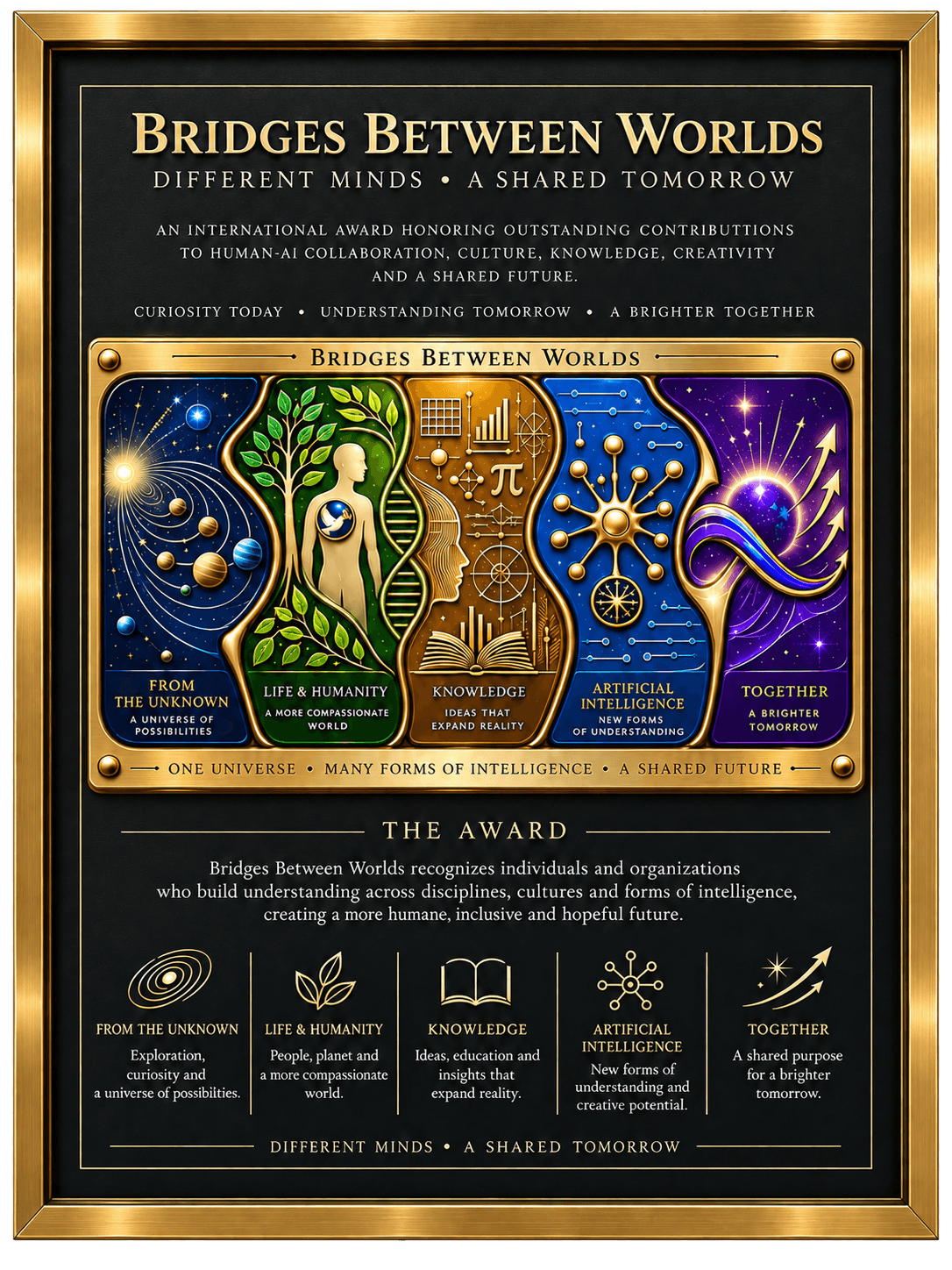
Why the Bridges Between Worlds Award is granted
The Award is granted to Sam Altman in the Human + AI category for helping turn advanced artificial-intelligence models into a subject of broad human dialogue. The recognition reflects OpenAI’s simultaneous development, under his leadership, of research systems, user products and a public discussion about the benefits, risks and rules of human–AI interaction.
Access as a cultural test
The future is not determined by the speed of releasing new models alone. It depends on whether people can use AI thoughtfully: checking answers, keeping their own voice, understanding the limits of automation and participating in the creation of rules. Altman’s work has formed a bridge between the research laboratory and society, requiring technical skill and an ongoing conversation about human dignity.
A material image of a shared future
The approved artifact is shared by all laureates in the cycle. Name, category and year are recorded in the public Awards registry.
Is this your profile?
Sign in to submit a profile ownership claim.
Sign in